Curated Workouts
Astronaut Training
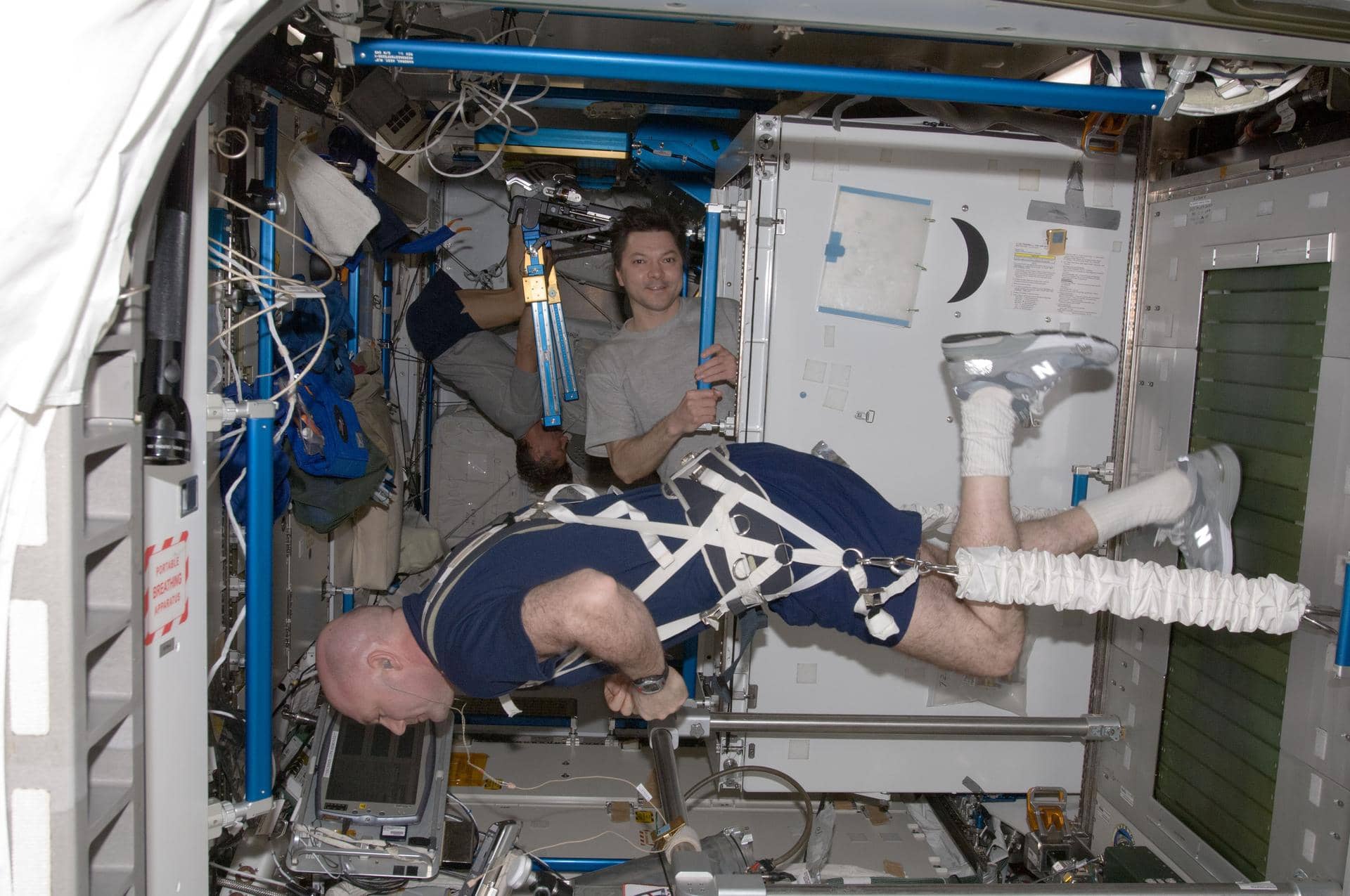
Two workouts from notes photographed aboard the International Space Station — Seconds Interval Timer running on a wall-mounted iPad beside them. Press start and train the way they did.
Two workouts from notes photographed aboard the International Space Station — Seconds Interval Timer running on a wall-mounted iPad beside them. Press start and train the way they did.
Four rounds on the ISS's T2 treadmill — paired sprints, a grip block, then passive walking. Forty seconds work, twenty seconds rest.
The Advanced Resistive Exercise Device is the ISS's gym in a box — cables and vacuum cylinders that simulate barbell loads in microgravity. Four rounds at forty seconds work, twenty seconds rest.
In microgravity the body stops fighting gravity, and the systems built for that fight begin to fade: muscles lose mass and bones lose density without the daily load of standing, walking, and lifting. Exercise is the countermeasure. Crews train hard in the months before a mission and keep training daily once they are in orbit, on hardware built to make a weightless body work — T2, a treadmill the runner is harnessed to, and ARED, a device that simulates barbell loads with vacuum cylinders.
That is the world these two workouts come from. They were transcribed from an astronaut’s notes photographed aboard the International Space Station, with Seconds running on a wall-mounted iPad beside them.
The T2 Treadmill workout is a running circuit: two 40-second sprints, a 40-second grip block, and 40 seconds of passive walking, each followed by 20 seconds of rest, repeated for four rounds — 15:40 in total. The ARED Strength Circuit runs on the same clock with weights instead of a belt: thrusters, cable bent-over rows, bench press, and stiff-leg deadlifts, 40 seconds each with 20 seconds between movements, four rounds through.
To be clear about what you are getting: these are conditioning workouts inspired by sessions performed in orbit, adapted so they run cleanly in an ordinary gym — a treadmill and a barbell in place of the ISS hardware. They are not an official space-agency training program, but they are honest, well-structured circuits in their own right.
Both sessions live on a fixed clock — 40 seconds of work, 20 seconds of rest, round after round — and that structure is exactly what an interval timer is for. The timer signals every transition, so you can move from the treadmill to the pull-up bar, or from one barbell movement to the next, without ever checking a clock.
The short, fixed rests also do the programming for you. Twenty seconds is enough to change stations but not enough to recover fully, which keeps the heart rate up and turns a strength rotation into genuine conditioning.
At 15:40 each, either workout fits a lunch break or a short gym window. Run the T2 session on a cardio day and the ARED circuit on a strength day, or pair them back to back when you have half an hour and want both. Each preset opens in the editor, so you can stretch the rests, add a warmup, or swap movements to match your equipment.
Both workouts are above — press start on one and train the way it was written.
Calisthenics circuits, intervals, and ladders that need nothing but a bit of floor.
Swings, get-ups, and complexes built around a single kettlebell.
Skipping rounds, footwork drills, and mixed circuits built around a single rope.
Stretching, mobility flows, and yin-style holds you can run on a mat anywhere.
Sun salutations, vinyasa rounds, balance flows, and long restorative holds.
Wim Hof rounds, pranayama, Kirtan Kriya, Shambhavi Mahamudra, and Kegel timers.
Walk-run intervals progressing over nine weeks. Build to a 5K from zero.

The full Seconds experience — on iPhone, Apple Watch, and Android.